
Our Negative & Slide Scanning Process
- Handling of negatives/slides with lint-free cotton gloves.
- Each negative/slide is cleaned and air-dusted with hand puffer (no canned air).
- Negatives/slides are scanned first scanned at 48-Bit TIF 3600 dpi, then converted to 24-Bit JPG at 3600 dpi.
- Negatives/slides pass-through a four (4) scan process:
-
- Negatives/slides sharpened using Ai technology.
- Multi-Exposure Ai technology for proper contrast balancing.
- Negatives/slides scanned with infrared technology to remove dust and scratches.*
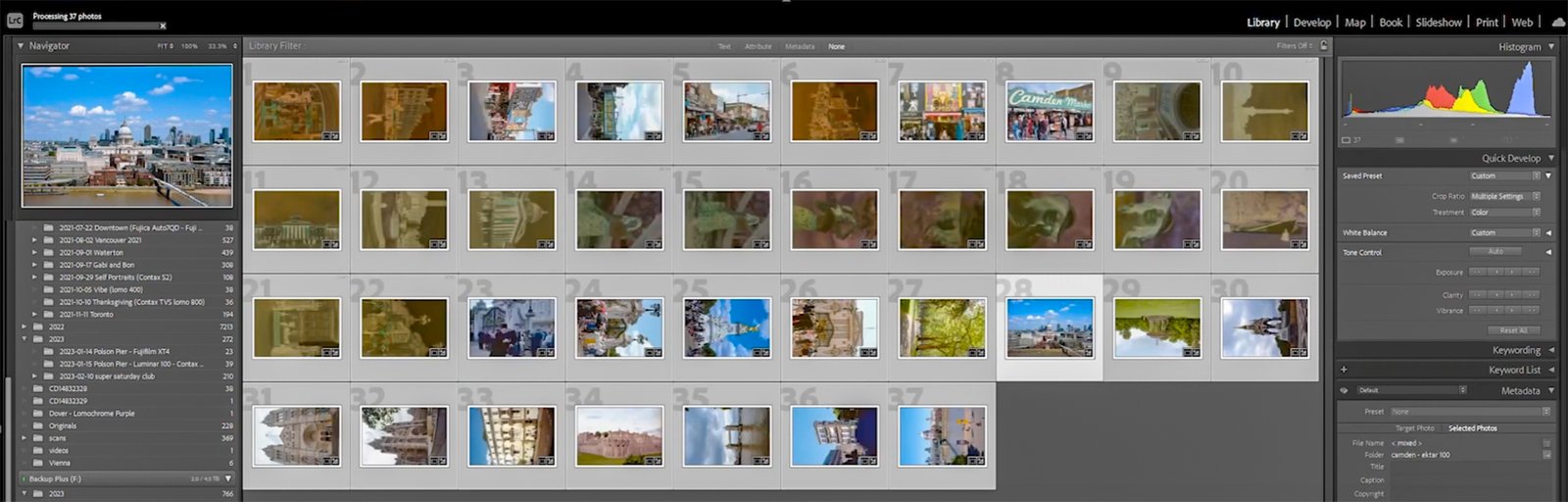
- Negatives/slides are exported to Photoshop Lightroom for further colour-balancing and editing.
- Scans saved to USB drive for additional fee and also uploaded to OneDrive for downloading.
Copies of customer scans are saved for one year, so be sure to save backup files to several different drive or cloud storage devises.
* Infrared technology cannot be used on black & white negatives or slides. However, you can hire from dozens of inexpensive and professional editors on Fiverr to digitally remove dust and scratches from your negatives or slides.

A Word About Slide Scanning
If you’ve viewed a properly exposed slide, you are likely quite amazed at how beautiful the image looks. It almost looks 3D! The colours are vivid, blacks are very black, and highlights provide well-defined colour and detail too.
In the worlds of photography, videography, and cinematography, dynamic range is the proportion of light to dark tones in an image. Dynamic range is the steps of light in an image from the darkest of dark to the brightest of bright.
Although slide films provide a narrow dynamic range when photographing a subject, the developed slide film provides an image with a density range of about 14 stops. These stops are the different levels of dark to bright including the colours within them. So the darks colours in the shadows still remain vivid in a slide, and this makes slide scanning very challenging using standard scanning machines and software.
I have been involved in the photographic industry since 1975 and converting slides to prints has always been challenging and nearly impossible to cost-effectively reproduce. And not all slides scan the same! A perfectly exposed slide can develop “issues” during the infrared dust removal process. Or, two slides that are nearly identical can end up providing results that are slightly different (one less contrast or more muddy than the other).
There are slide scanning services available that use an £18,000 scanning machine that produces some of the best scans possible, but those companies will charge between £9.00 and £25.00 per frame, per scan! Other printing companies offer direct digital printing from slide films, but the costs can become quite excessive.
I mention this information about slide scanning because I’m a perfectionist when it comes to photography and the photographic industry. And I am quite amazed that in the 21st century, we still have not perfected the ability to scan a slide and create a digital copy that is as vivid as the original. In fact, I will take some of my own slides from the seventies to another London company and rent their £18,000 scanner for the day, just to ensure I obtain the highest quality possible for my own precious slide memories.
Please know that when I scan your slides, I will do my upmost best to provide you with digital images that will as best as possible. And that’s the reason for my £3.00 per image prices.
London Negative and Slide Scans is owned and operated by Frank Biganski, a seasoned London property photographer with a photographic career that began in 1975. Frank’s first job was working as a photo lab technician where he developed massive amounts of colour 35mm negative and slide films. Frank learned early-on how to properly handle negative films, and that care has transcended into how he archives and handles negatives today.
For those looking for cheap and quick scans, Frank’s services are not for you.
Frank just doesn’t “scan negatives” quickly. Frank’s scanning process involves a time-consuming 4-step process that ensures you receive the highest quality scan of your precious memories. After the first scan, an additional infrared scan is performed to remove dust and scratches using AI technology.
Frank first scans your negatives as “negatives” and then exports them into Photoshop Lightroom. In Lightroom, each negative is colour-balanced to “white”, which is the decades-old standard to ensuring your negatives produce the proper colour your original negatives were intended to produce.
Since 1932, thousands of film types have been developed to create distinct looks or styles when printed on paper. Frank’s scanning process and software are designed to faithfully reproduce those original aesthetics. In turn, this delivers images that will appear today just as they were meant to over 50 years ago.